
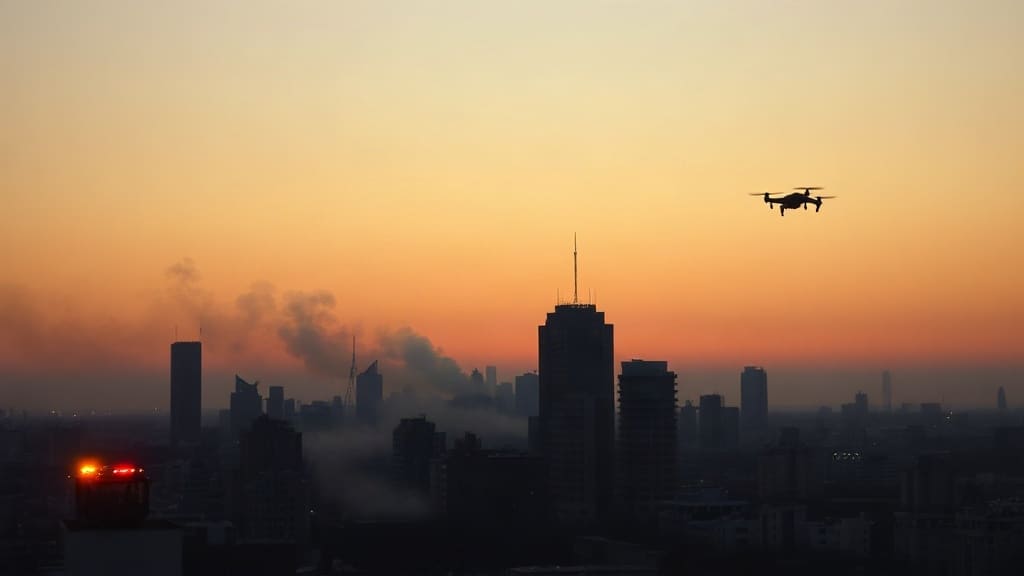
The predawn calm of Kyiv shattered on Tuesday as waves of Russian drones struck the Ukrainian capital, leaving at least two people dead and sending residents scrambling for shelter. For weeks, the city had experienced a relative lull in direct attacks, but the overnight assault served as a grim reminder that the war remains very much at Kyiv's doorstep. Air raid sirens wailed for hours, and the thud of explosions mixed with the crackle of air defense systems trying to intercept the incoming threats.
While the full scope of the damage is still being assessed, the attack underscores a shift in Russia's approach: a sustained campaign of drone and missile strikes aimed at wearing down Ukrainian morale and degrading critical infrastructure as winter approaches. For ordinary Kyivans, it was another night of interrupted sleep, fear, and the familiar ritual of moving to corridors, basements, or metro stations. But beyond the immediate tragedy, the strike raises hard questions about the resilience of Ukraine's air defenses and the trajectory of the war as it grinds toward another year.
What happened in Kyiv overnight?
According to Ukraine's military administration, Russia launched multiple waves of Shahed kamikaze drones at the capital and surrounding regions starting in the early hours of Tuesday. The drones, Iranian-designed and now produced in Russia, have become a staple of Moscow's long-range strike campaign. They fly low and slow, but their sheer numbers can overwhelm air defenses, and their warheads are enough to cause significant damage to residential and civilian targets.
Explosions were reported in several districts, including Solomianskyi and Shevchenkivskyi, both densely populated areas with a mix of apartment blocks, offices, and historical buildings. At least two people were confirmed dead by city officials, and several others were injured, including one person pulled from the rubble of a damaged building. Emergency crews worked through the morning to search for survivors and secure damaged structures.
Kyiv's mayor, Vitali Klitschko, said that debris from intercepted drones fell in multiple locations, causing fires and damaging cars and buildings. He urged residents not to ignore air raid warnings and to remain in shelters until the all-clear was given. The Ukrainian Air Force reported that air defenses shot down a significant number of drones, but acknowledged that some got through.
Why is Russia targeting Kyiv again?
Kyiv has been a symbolic and strategic target since the first days of the full-scale invasion in February 2022. Capturing or devastating the capital was a key Russian objective early on, but the attempt failed. Since then, Moscow has periodically hit Kyiv with missiles and drones, often in response to Ukrainian strikes on Russian territory or to coincide with diplomatic events.
Military analysts suggest that the latest wave may be part of a broader effort to strain Ukraine's air defense systems by forcing them to expend scarce interceptor missiles and expose their positions. Russia has also been targeting Ukraine's energy grid ahead of the cold season, a tactic used effectively in the winter of 2022–2023 to cause blackouts and heating failures. While Tuesday's strikes appeared to focus on the capital, similar attacks were reported in other regions, including Kharkiv and Odesa.
There is also a psychological dimension. By striking the capital, Russia aims to show that no part of Ukraine is safe, even far from the front lines. For Ukrainian leaders, the attacks are a reminder of the need for more advanced air defense systems from Western partners, a request that has been central to President Volodymyr Zelensky's diplomatic outreach.
The human cost of drone warfare
Beyond the strategic calculations, the strikes have a very human cost. The two people killed on Tuesday were not soldiers; they were civilians going about their lives in a city that has tried to maintain a sense of normalcy despite the war. Their deaths add to a toll that, according to the United Nations, has exceeded 10,000 civilian fatalities in Ukraine since the invasion began, though the true number is likely higher.
For residents, the psychological toll is equally heavy. The sound of a low-flying drone or the sudden wail of an air raid siren can trigger panic, especially for children and the elderly. Many Kyivans have developed routines around the threat: keeping a go-bag by the door, sleeping in hallways, or tracking real-time air alert apps. The constant state of vigilance wears on people, even when attacks are not happening.
One resident, who asked not to be named, described hearing a series of explosions near her apartment building. "You never get used to it," she said. "Every time, you think it might be the last thing you hear." Her words echo the sentiment of millions across Ukraine who live under the shadow of Russian air power.
Ukraine's air defense challenge
Ukraine has become increasingly adept at shooting down Russian drones and missiles, thanks in large part to Western-supplied systems like Patriot, NASAMS, and IRIS-T. But the cost of each interceptor is high, and the supply is finite. Russia, meanwhile, has ramped up production of Shahed drones and continues to import components from Iran and other countries, despite sanctions.
The result is a lopsided economic equation: a drone that costs tens of thousands of dollars can force Ukraine to fire a missile that costs hundreds of thousands, or even millions, to stop it. This asymmetry is a key reason why Ukraine has been pushing for more advanced systems and for permission to strike drone launch sites inside Russia. Western allies have been reluctant to allow such strikes, fearing escalation, but the pressure is growing as civilian casualties mount.
There are also gaps in coverage. Ukraine's air defense network is stretched thin, and drones can slip through in areas where coverage is less dense. The use of decoy drones and swarming tactics further complicates interception. As a result, even a "successful" defense can result in debris falling on populated areas, causing damage and casualties.
What comes next?
The attack on Kyiv is unlikely to be the last. Russia has shown a willingness to continue long-range strikes regardless of the situation on the front lines. As winter sets in, the risk to Ukraine's energy infrastructure will grow, and with it the potential for humanitarian crisis. Ukrainian officials have warned that Russia may be stockpiling missiles for a renewed campaign, and Western intelligence assessments suggest the same.
For Ukraine, the immediate priority is to bolster air defenses and repair damage quickly. The government has also been working to decentralize the energy grid, making it harder to knock out power to large areas with a single strike. But these measures take time and money, and the war shows no sign of ending soon.
Diplomatically, the strikes may reinforce Ukraine's arguments for more military aid. Zelensky has repeatedly said that air defense is not just about protecting Ukraine but about defending the rules-based international order. Whether that message resonates in Western capitals, where political will is sometimes waning, remains to be seen.
In the meantime, the people of Kyiv will do what they have done since the first day of the war: adapt, endure, and hope that the next night is quieter. But as Tuesday's attack showed, the threat is never far away.
Frequently asked questions
How many people were killed in the Kyiv drone strikes?
At least two people were confirmed dead and several others injured in the drone strikes on Kyiv on Tuesday. Emergency services were still working to assess the full extent of casualties and damage.
What kind of drones did Russia use in the attack?
Russia used Shahed kamikaze drones, which are Iranian-designed and now manufactured in Russia. These drones are relatively cheap and can be launched in large numbers to overwhelm air defenses.
Why does Russia keep targeting Kyiv?
Kyiv is a symbolic and strategic target for Russia. Attacks on the capital aim to undermine Ukrainian morale, strain air defenses, and disrupt daily life, especially ahead of winter when energy infrastructure is more vulnerable.
Can Ukraine's air defenses protect against drone swarms?
Ukraine has improved its ability to intercept drones, but the sheer volume of attacks and the high cost of interceptor missiles create challenges. Debris from downed drones can also cause damage, making perfect defense difficult.
What is the international response to the strikes?
International leaders have condemned the strikes and reiterated support for Ukraine's air defense needs. The attacks are likely to increase pressure on Western allies to provide more advanced systems and possibly allow strikes on launch sites inside Russia.