
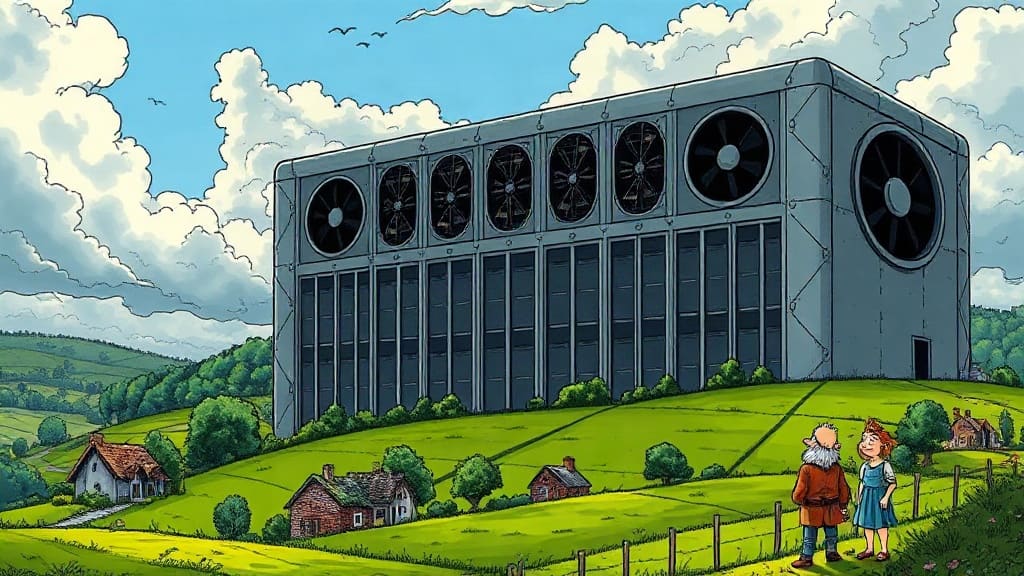
The humble data centre, once a nondescript box on an industrial estate, has become one of the most contested pieces of infrastructure in modern Britain. In his latest cartoon, Ben Jennings captures this transformation with a sharp, satirical eye, depicting the moment when the nation's digital dreams collide with the physical realities of land, power, and people. The image is deceptively simple: a vast, windowless building looms over a small village, its cooling fans humming like a mechanical heartbeat, while a group of locals peer up in bewilderment. A sign reads 'AI Data Centre – Coming Soon', but the promise feels less like progress and more like an invasion.
Jennings has long been a master of visual commentary, using minimal detail to maximum effect. Here, the data centre is not just a building; it is a metaphor for the unseen forces reshaping the British landscape. The cartoon arrives at a moment when the country is grappling with an uncomfortable question: can it become a global hub for artificial intelligence without sacrificing the very communities that make it liveable?
The Data Centre Boom: Britain's Digital Gold Rush
Britain is in the midst of a data centre building spree. Driven by the explosive growth of cloud computing, streaming services, and, most critically, artificial intelligence, the demand for server space has never been higher. The government has actively courted tech giants, streamlining planning processes and offering tax incentives to attract investment. The result is a wave of new facilities springing up from the Thames Valley to the Scottish Highlands, often on greenfield sites that were once farmland or open countryside.
These data centres are not just large; they are colossal. A typical hyperscale facility can cover hundreds of thousands of square feet, consuming as much electricity as a small town and requiring vast amounts of water for cooling. The sheer scale of these projects has sparked a backlash from local residents, environmental groups, and even some politicians who fear the infrastructure is being imposed without adequate consultation or consideration of long-term impacts.
The Energy Conundrum: Powering the AI Revolution
At the heart of the debate is energy. Data centres are voracious consumers of electricity, and the UK's grid is already under strain. The government's push for AI leadership has led to a scramble for power sources, with some proposals including dedicated gas plants or even small modular nuclear reactors to feed the data centres. Critics argue that this approach undermines the country's net-zero commitments, locking in fossil fuel dependence for decades to come.
Jennings' cartoon hints at this tension through a subtle detail: the data centre's cooling fans are depicted as giant, swirling vortexes, sucking in not just air but the very lifeblood of the surrounding landscape. It is a powerful visual metaphor for the resource extraction that underpins our digital lives, a reminder that every online interaction has a physical cost.
Community Backlash: Not in My Backyard?
The rise of data centres has provoked a wave of local opposition. Residents near proposed sites have raised concerns about noise from cooling systems, visual blight, and the strain on local infrastructure such as roads and water supplies. In some areas, campaigns have sprung up with names like 'Save Our Green Belt' and 'No Mega Data Centre', reflecting a deep-seated anxiety about the pace and scale of development.
Jennings' cartoon captures this sentiment with empathy. The villagers in his drawing are not portrayed as Luddites or technophobes; they are ordinary people confronted by a force far beyond their control. Their expressions are a mix of confusion and resignation, a recognition that decisions about their environment are being made in boardrooms and government offices far away.
The Political Dimension: A Government Caught in the Middle
The Labour government, elected in 2024, has made AI and digital infrastructure a cornerstone of its economic strategy. Ministers argue that data centres are essential for job creation, innovation, and national competitiveness. They point to the success of tech hubs in Ireland and Scandinavia, and warn that Britain risks falling behind if it does not embrace the digital revolution.
Yet the government is also acutely aware of the political risks. The Liberal Democrats and the Green Party have seized on the issue, accusing Labour of sacrificing environmental protections and local democracy for the sake of corporate interests. Some Labour backbenchers have expressed unease, particularly in rural constituencies where data centre proposals are most contentious. The cartoon's timing is therefore significant, arriving just as the debate shifts from abstract policy to concrete planning battles.
The Environmental Impact: More Than Just Carbon
Beyond energy consumption, data centres have a broader environmental footprint. The construction of these massive facilities requires vast quantities of concrete and steel, with significant embodied carbon. Their cooling systems often rely on water, putting pressure on local supplies in areas already prone to drought. And the electronic waste generated by constantly upgrading servers adds to the growing problem of e-waste.
Jennings' cartoon does not shy away from these issues. The data centre in his drawing is depicted as a monolithic, grey slab, its walls devoid of windows or any humanising features. It is a stark contrast to the lush, green countryside that surrounds it, a visual reminder of the environmental cost of our digital addiction.
The Economic Promise: Jobs and Growth
Proponents of data centres argue that they bring significant economic benefits. Construction projects create thousands of short-term jobs, while the facilities themselves require skilled technicians for maintenance and operations. There is also the promise of spin-off industries, from renewable energy projects to fibre optic networks. For some communities, a data centre can be a lifeline, bringing investment to areas that have suffered from deindustrialisation.
But critics counter that these benefits are often overstated. Data centres are highly automated, employing relatively few people once operational. The jobs they do create are often filled by specialists from outside the local area, and the tax revenues they generate can be offset by the infrastructure costs they impose. Jennings' cartoon hints at this imbalance: the data centre dominates the landscape, but the villagers seem to gain nothing from its presence.
The Global Context: Britain in the AI Race
Britain's data centre boom cannot be understood in isolation. The country is competing with the United States, China, and the European Union for dominance in artificial intelligence. Each nation is pouring billions into digital infrastructure, seeking to attract the tech giants that will shape the future economy. In this global race, data centres are the physical embodiment of ambition, the concrete and steel that will house the algorithms of tomorrow.
Jennings' cartoon places this global competition in a local context. The data centre in his drawing may be a symbol of national aspiration, but it is also an imposition on a specific place and a specific community. The cartoon asks a difficult question: who bears the cost of progress, and who reaps the rewards?
The Role of Satire in the Debate
Satire has always played a crucial role in political discourse, using humour to expose hypocrisy and challenge power. Jennings is part of a long tradition of British cartoonists, from Gillray to Low, who have used their art to hold the powerful to account. His cartoon on data centres is a masterclass in this tradition, condensing a complex policy debate into a single, memorable image.
The cartoon's power lies in its ambiguity. It does not offer easy answers or take sides. Instead, it invites viewers to reflect on the choices being made in their name, and to consider the kind of future they want to build. In an age of information overload, a well-crafted cartoon can cut through the noise and spark genuine debate.
Conclusion: A Cartoon That Asks the Right Questions
Ben Jennings' cartoon on the rise of data centres in Britain is more than just a witty observation; it is a timely intervention in one of the most important debates of our era. As the country rushes to embrace the digital future, his image serves as a reminder that progress is never without cost. The data centre in his drawing may be a marvel of engineering, but it is also a symbol of the tensions between global ambition and local impact, between economic growth and environmental sustainability, between the promise of technology and the realities of place.
In the end, the cartoon does not tell us what to think. It simply asks us to look. And in looking, we are forced to confront the choices that will shape Britain's landscape, its economy, and its communities for generations to come.
Frequently Asked Questions
Why are data centres being built in Britain?
Data centres are being built in Britain to meet the growing demand for cloud computing, streaming services, and artificial intelligence. The government has actively encouraged this development as part of its strategy to make the UK a global leader in AI and digital technology.
What are the main concerns about data centres?
The main concerns about data centres include their high energy consumption, which can strain the grid and increase carbon emissions; their water usage for cooling; their visual impact on the landscape; and the strain they place on local infrastructure such as roads and water supplies. There are also worries about the lack of community consultation in the planning process.
How many data centres are there in the UK?
The exact number of data centres in the UK is constantly changing as new facilities are built. However, the country is one of the largest data centre markets in Europe, with a significant concentration in the London area and growing clusters in other regions such as Manchester, Birmingham, and Scotland.
Are data centres good for the economy?
Data centres can bring economic benefits during construction and through ongoing operations, but their long-term economic impact is debated. They create some jobs, but relatively few for their size, and the tax revenues they generate may be offset by the infrastructure costs they impose. Some argue that the real economic benefits accrue to the tech companies that own the facilities, rather than to local communities.
What is the government doing about data centre concerns?
The government has introduced measures to streamline planning for data centres and has emphasised their importance for national competitiveness. However, it has also faced pressure to address environmental and community concerns. Some policies have been proposed to encourage the use of renewable energy and to improve consultation with local residents, but critics say these measures do not go far enough.