
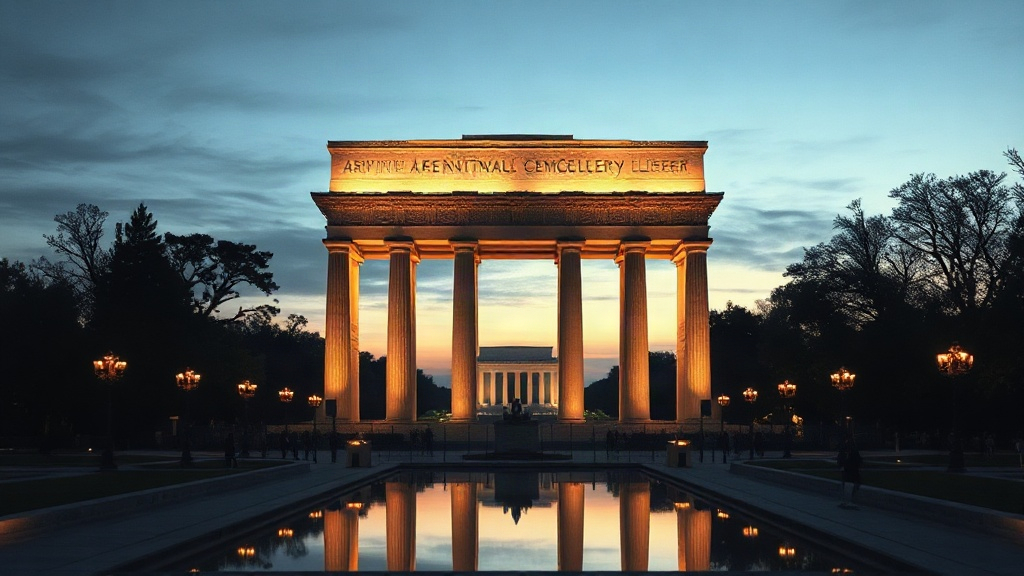
When President Donald Trump unveiled his vision for a grand triumphal arch in Washington, D.C., many expected a purely symbolic monument celebrating American military victories. But in a surprise announcement over the weekend, Trump revealed that the structure would also house "a top grade military complex," a revelation that has left lawmakers and analysts scrambling to understand the implications. The proposed arch, to be situated between Arlington National Cemetery and the Lincoln Memorial, would not only serve as a tourist attraction but also as a secure facility with rapid deployment capabilities.
The announcement, made via a post on his social media platform, described the arch as a multi-purpose installation that would "house, store, and have the rapid ability" to support military operations. While Trump framed the idea as a bold enhancement of national security and patriotic pride, critics swiftly condemned it as an alarming militarization of a sacred memorial space. The plan has ignited a fierce debate over the appropriate use of public land, the balance between security and symbolism, and the legacy of the nation's capital.
Background: The Arch That Wasn't Supposed to Be a Base
The concept of a triumphal arch in Washington, D.C., is not entirely new. For years, various proposals have floated the idea of constructing a monument akin to the Arc de Triomphe in Paris or the Marble Arch in London, celebrating American military history. However, none had ever suggested incorporating an active military facility. The location between Arlington National Cemetery and the Lincoln Memorial is particularly sensitive, as it lies at the heart of the National Mall's commemorative landscape, flanked by the graves of fallen soldiers and the iconic Reflecting Pool.
Trump's latest statement appears to have caught even his own advisors off guard. According to sources familiar with the matter, the original plan was for a purely decorative arch, funded through private donations and intended to be completed by 2026. The addition of a military complex, which would presumably include command centers, storage for equipment, and possibly barracks, represents a significant departure from that vision. The White House has not released detailed blueprints, leaving many questions unanswered about the scale, cost, and operational scope of the facility.
Immediate Backlash: 'Gonzo Bonkers' and Beyond
The reaction from Capitol Hill was swift and bipartisan. Senator Lisa Murkowski (R-Alaska) called the idea "gonzo bonkers," a phrase that quickly went viral. "We're talking about placing a military installation in the middle of our most hallowed ground," she said in a statement. "This isn't about honoring our troops; it's about turning a memorial into a fortress." Representative Ted Lieu (D-Calif.) echoed the sentiment, tweeting that the plan was "an insult to the millions who visit Arlington to pay their respects."
Analysts also raised concerns about the practical and symbolic ramifications. Dr. Sarah Wilkinson, a historian of American memorials at Georgetown University, noted that the National Mall is designed to be a space for reflection and unity, not militarization. "The Lincoln Memorial and Arlington Cemetery are sacred spaces that represent healing and remembrance," she said. "Introducing a military complex there would fundamentally alter their character and could even jeopardize their status as national treasures."
Others pointed out that the plan might violate existing laws and regulations. The National Capital Planning Commission and the Commission of Fine Arts, which oversee development in the District, would need to approve any construction. Given the controversial nature of the proposal, approval seems unlikely without significant modifications. Additionally, the National Environmental Policy Act could require extensive reviews, further delaying the project.
Why This Matters: Security, Symbolism, and the Soul of the Capital
At its core, the debate over Trump's arch touches on deeper questions about the role of the military in American public life and the meaning of national monuments. Supporters argue that a military presence would enhance security in an era of heightened threats and provide a visible tribute to the armed forces. They envision a structure that combines the grandeur of a triumphal arch with the functionality of a modern command center, symbolizing strength and readiness.
Critics, however, see it as a dangerous precedent. They worry that militarizing a memorial site could erode the distinction between civilian and military spheres, turning a place of mourning into a potential target. Moreover, the arch's location between Arlington and the Lincoln Memorial is steeped in history: Arlington House, the Robert E. Lee Memorial, sits atop the cemetery, while the Lincoln Memorial symbolizes reconciliation after the Civil War. Injecting a military complex into this narrative could create a jarring juxtaposition.
The controversy also highlights the broader trend of Trump's unconventional approach to governance and his willingness to challenge established norms. Throughout his presidency, he has frequently proposed bold, often controversial projects, from a border wall to a Space Force. The arch plan fits this pattern, blending grandiose vision with practical military considerations. But unlike some of his other initiatives, this one directly impacts a cherished national landmark, making it a lightning rod for opposition.
Potential Impacts on Tourism and Local Residents
Beyond the symbolic debate, the proposed military complex could have tangible effects on the daily life of the capital. The National Mall attracts over 25 million visitors annually, and any construction would disrupt traffic and access to popular sites. Residents in nearby neighborhoods, such as Foggy Bottom and Arlington, might face increased security checkpoints, noise, and restricted airspace. Local businesses that rely on tourism could suffer during prolonged construction phases.
Furthermore, the presence of a military facility might necessitate heightened security measures, including barriers and surveillance, which could detract from the open, welcoming atmosphere of the Mall. Some fear that the arch could become a fortified enclave, inaccessible to the public it is meant to honor. The National Park Service, which manages the Mall, has not commented on how it would accommodate such a facility.
Legal and Financial Hurdles
Even if the political will existed, the project faces significant legal and financial obstacles. The estimated cost of building a triumphal arch with a military complex could run into hundreds of millions of dollars, far exceeding the original private funding plan. Congress would likely need to appropriate funds, triggering a heated debate over budget priorities. Additionally, the design would have to pass rigorous reviews by multiple agencies, each with the power to halt or modify the proposal.
Legal experts suggest that opponents could file lawsuits citing environmental impact, historic preservation, and zoning laws. The National Historic Preservation Act, for instance, requires federal agencies to consider the effects of their actions on historic properties. Given the arch's proximity to Arlington National Cemetery, a designated National Historic Landmark, any construction would face intense scrutiny.
What's Next for the Arch?
As of now, the proposal remains just that: a proposal. No formal legislation has been introduced, and no groundbreaking date has been set. The White House has indicated that it is "exploring options," but has not provided a timeline. In the coming weeks, we can expect hearings, protests, and perhaps alternative designs that exclude the military component.
For now, the controversy serves as a reminder of how deeply Americans care about their national symbols and the stories they tell. Whether Trump's arch becomes a reality or fades into the annals of unbuilt monuments, the debate it has sparked will likely influence future discussions about the intersection of memory, security, and public space.
Frequently Asked Questions
What exactly is Trump's triumphal arch plan?
It is a proposal to build a triumphal arch between Arlington National Cemetery and the Lincoln Memorial that would also house a military complex with rapid deployment capabilities, according to Trump's recent statements.
Why are people opposed to the arch?
Opponents argue that placing a military facility in a sacred memorial space militarizes the National Mall, disrespects the fallen, and could disrupt tourism and local life. They also cite legal and financial concerns.
Has the arch been approved?
No. The project would require approval from multiple agencies and likely congressional funding. It is currently only a proposal with no formal legislative action.
What does 'gonzo bonkers' mean in this context?
Senator Lisa Murkowski used the phrase to describe the plan as wildly impractical and inappropriate, capturing the disbelief and criticism from many lawmakers.
Could the arch still be built without the military complex?
Yes, some supporters have suggested that a purely commemorative arch could proceed, but the military aspect has become a major sticking point. The final design remains uncertain.