
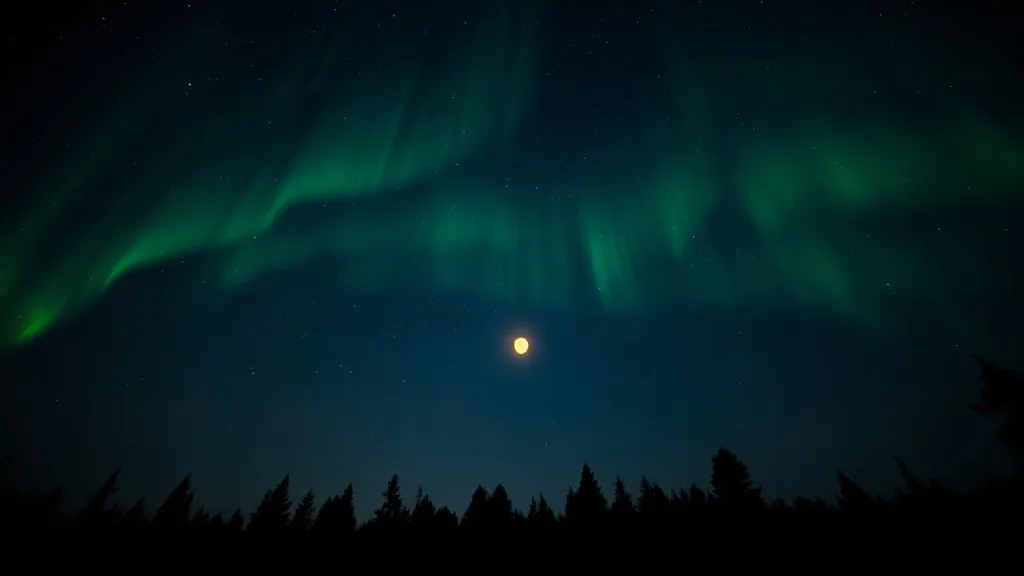
Some sky photographs are planned months in advance, with ephemeris tables, weather models and a car packed the night before. Others happen because someone looked up at the right moment. The Astronomy Picture of the Day published for 14 October 2026 belongs firmly to the second category: a single frame from northern Sweden in which Mars sits inside the Beehive cluster, an auroral curtain sweeps across the upper sky, and a dark treeline anchors the bottom of the picture near Lansjarv.
What makes the frame worth more than a passing glance is that three unrelated pieces of astronomy had to agree at once. A planet on a predictable track, a star cluster thousands of light years away, and a burst of solar particles interacting with Earth's magnetic field all had to line up inside one camera's field of view. None of them coordinated with the others.
What the Photograph Actually Shows
The scene is a wide-field nightscape rather than a telescopic close-up. Mars appears as a bright, slightly warm-toned point of light, noticeably brighter than the stars around it, embedded in a loose scattering of faint suns. That scattering is the Beehive, also catalogued as M44 or Praesepe, an open cluster in the constellation Cancer.
Above the pair, a green glow spreads across the sky in ribbons and vertical striations. This is the classic signature of auroral oxygen emission, the colour that dominates most naked-eye displays at high latitudes. Below, the dark silhouettes of small conifers frame the horizon. The overall composition reads almost like a landscape painting with a planet dropped into it.
The location matters. Lansjarv sits in Norrbotten, well inside the auroral oval, where displays are common enough that local photographers treat them as routine rather than rare. That familiarity is exactly why an image like this can exist: someone was already outside, already set up, already watching.
Why Mars in the Beehive Is a Real Coincidence
The Beehive cluster is one of the nearest open clusters to the solar system, and it is bright enough to have been recorded as a fuzzy patch by observers long before telescopes resolved it into individual stars. It sits close to the ecliptic, the plane traced by the Sun and the planets across our sky.
That proximity to the ecliptic is the key. Because the planets never wander far from that line, they periodically pass in front of, or close to, the Beehive. Mars does it roughly every couple of years, but not always this centrally. When the geometry works out, the red planet appears to sit among the cluster's stars, even though it is only a few light minutes away while the cluster's stars are hundreds of light years distant.
The illusion is a useful reminder of how poorly human intuition handles depth in the sky. Two objects that look adjacent in a photograph can be separated by a gap that no spacecraft has ever come close to crossing.
What Makes This Alignment Different
Conjunctions between planets and the Beehive are not headline astronomy. They are the sort of thing amateur observers note in a logbook and move on from. What lifts this particular frame above the routine is the aurora.
An auroral display is driven by charged particles from the Sun, funnelled along Earth's magnetic field lines toward the polar regions, where they excite oxygen and nitrogen in the upper atmosphere. The process is inherently unpredictable on short timescales. Forecasters can estimate the likelihood of activity from solar wind data, but the exact moment a curtain brightens or fades is not something anyone can schedule.
So the photograph required a planetary alignment that recurs on a known rhythm, a star cluster sitting in the right place, clear skies, and a geomagnetic disturbance arriving at the same hour. Three of those four are essentially luck.
Reading the Aurora in the Frame
The green tones in the image are not a camera artefact or an artistic choice. They correspond to a specific emission line of atomic oxygen at roughly 557.7 nanometres, a wavelength the human eye is most sensitive to in dark conditions. That is why green dominates so many auroral photographs and why displays often look colourless to observers but vividly green in long exposures.
The vertical structure visible in the curtains is equally informative. Auroral arcs are not flat sheets of light; they are shaped by the geometry of the magnetic field and by the energy of the incoming particles. Finer, faster-moving rays tend to appear during more active periods, while slower, more diffuse glows suggest gentler precipitation. Photographers who spend enough nights outside learn to read these differences and to judge whether a display is about to intensify.
Why Long Exposures Flatter the Sky
A camera left open for several seconds collects far more light than the eye can in a fraction of a second. That is why nightscape images often show more stars, more colour and more structure than the photographer actually saw. It is also why the Beehive's faint stars appear clearly here, while a casual observer might have seen only a smudge next to Mars.
This gap between photographic and visual appearance is worth keeping in mind. It does not make the image misleading, but it does mean the photograph represents an accumulation of time rather than a single instant of human perception.
Open Clusters as Time Capsules
The Beehive is more than a pretty backdrop for a planet. Open clusters like it are laboratories for understanding how stars form and evolve together. Their members share an origin, an age and a chemical composition, which makes them unusually clean samples for testing models of stellar evolution.
Because the stars in a cluster are born from the same collapsing cloud, astronomers can compare them directly. Differences in brightness and colour then reflect differences in mass rather than differences in history. That is a powerful simplification, and it is one reason clusters have been central to stellar astronomy for well over a century.
Clusters also disperse over time. Gravitational encounters with other stars and with giant molecular clouds gradually strip members away, so an open cluster is a temporary arrangement. The Beehive we see now is a snapshot of a group that will not hold together indefinitely.
The Value of Amateur Nightscape Photography
Images like this one rarely come from large observatories. Research telescopes are designed for precision, not for wide, aesthetically composed views that include a treeline. That leaves a genuine gap which amateur and semi-professional photographers fill.
Their work serves several purposes beyond aesthetics. It documents auroral behaviour across many locations and nights, it captures transient events that professional surveys may not prioritise, and it keeps a broad public engaged with the night sky. Outreach value is difficult to quantify, but the persistent popularity of daily astronomy images suggests the appetite is real.
- Wide-field frames place objects in context that close-ups cannot.
- Repeated observations from one site build a record of local sky conditions.
- Accessible equipment lowers the barrier for newcomers to try the same thing.
How to Catch a Similar Scene Yourself
Anyone hoping for a comparable photograph needs three things working together: a target worth framing, dark skies, and patience with weather. The practical steps are less glamorous than the result.
- Check planetary positions ahead of time. Conjunctions and cluster passages are predictable and appear in most astronomy almanacs and planetarium apps.
- Follow space weather forecasts for auroral activity, and treat them as probabilities rather than promises.
- Choose a location away from town lighting, with a clear northern horizon and something interesting in the foreground.
- Practise your exposure settings on ordinary nights so that you are not learning them while a display is fading.
- Bring more warm layers than you think you need. Northern observing sessions are long, and discomfort ends them early.
The last point is the one experienced night photographers repeat most often. Equipment can be replaced; enthusiasm is harder to recover once you have spent three hours shivering.
Frequently Asked Questions
Is the Beehive cluster visible to the naked eye?
Under genuinely dark skies, the Beehive appears as a faint, hazy patch rather than a collection of distinct stars. It sits in the constellation Cancer, close to the ecliptic, and it becomes much easier to spot through binoculars, where individual members begin to resolve.
How often does Mars pass near the Beehive?
Because the Beehive lies near the ecliptic, Mars moves through that region of sky roughly every two years or so, though the exact separation varies from pass to pass. Some encounters are wide and unremarkable; others bring the planet visually inside the cluster's boundaries.
Why is the aurora green instead of red or blue?
Green auroras come from atomic oxygen at altitudes where the density favours that particular emission. Red auroras involve oxygen at much higher altitudes, where collisions are rare enough for a slower transition to occur. Blue and purple tones usually involve nitrogen. The mix depends on altitude, particle energy and atmospheric composition.
Can auroras and a planet conjunction be predicted together?
Not reliably. Planetary positions are calculated years ahead with high precision, but geomagnetic activity depends on solar conditions that can only be forecast a few days out, and sometimes only hours. Planning a shot like this means preparing for the planetary half and hoping the solar half cooperates.
What equipment is needed for a nightscape like this?
A camera capable of manual exposure, a fast wide-angle lens, a sturdy tripod and a remote shutter release cover most of it. The technique matters more than the price tag: focus carefully on a bright star, expose long enough to gather light but not so long that stars trail, and shoot in raw format so you can adjust later.
What the Image Leaves Behind
Photographs of this kind do not usually change scientific understanding. Their contribution is different. They compress an enormous amount of physics into a frame that anyone can look at without a background in astronomy: a planet on its ancient circuit, a cluster of stars born together and slowly drifting apart, and a shimmer of excited oxygen driven by the Sun.
The coincidence is the point. Nothing in that sky arranged itself for the camera, and yet a moment arrived when the geometry, the weather and the solar wind all cooperated. Recognising that is a decent reason to keep looking up.